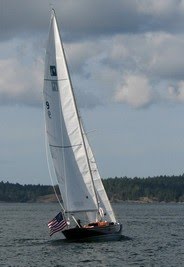
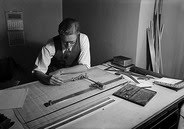
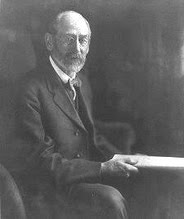
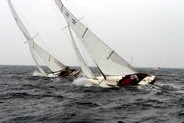
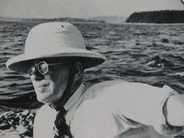
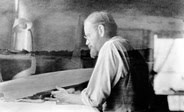
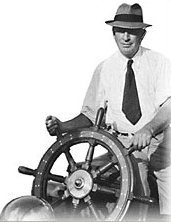
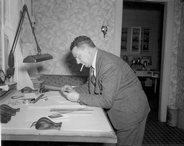
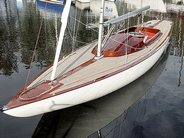
I stumbled onto this Mystic Seaport video on Olin Stephens while I was digging for info on the Knickerbocker Class.
Which of course lead me from one sailing video to another.
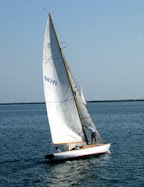
North American 8 Metre Racing.
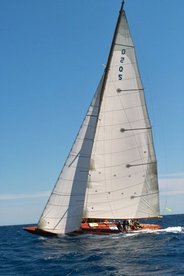
And Gerdny. A 95 Square Meter.
Thursday, March 25, 2010
Olin Stephens, Simply Brilliant
Posted by
Bill Evans
1 comments
Labels: Classic Boats, Olin Stephens
Sunday, September 21, 2008
Profile of Olin J. Stephens
Profile of Olin J. Stephens |
Written by and Published Courtesy of John Rousmaniere |
Article is Copyright Free |
Yacht designer Olin J. Stephens is Member Number 1 in the NYYC’s seniority list, having joined the club in 1930, or 78 years ago. This summer, as part of the NYYC Race Week at Newport Presented by Rolex, the club will celebrate a Classics Regatta and Olin J. Stephens 100th Birthday Celebration on July 18-20. Race Week Dates are July 18-27. This is a copyright-free excerpt from a chapter that first appeared in The Encyclopedia of Yacht Designers.
Nicholas Brown. Bolero is now owned by NYYC-member Ed. Kane. Ahead of Stephens is
John Rousmaniere, the author of this article and the NYYC Historian. Photo Rolex/Dan Nerney.
Stephens entered the Massachusetts Institute of Technology in 1926, only to be forced to drop out during his freshman year due to illness. Throughout his life, although he was a pioneer in scientific yacht design, he would say that he regretted his lack of training in mathematics and engineering. Yet Stephens had aptitudes that suited his calling. “I started my career with the tools of observation and intuition to which quantitative analysis has been gradually added,” he wrote in his autobiography. “Whenever possible I studied lines and tried to see the way shape was coupled to performance.”
By 1926 he was sailing regularly at Larchmont Yacht Club in Six Meters, a restricted-design keel boat of about 34 feet LOA and the hot racing class of the day with top-flight sailor-designers like Clinton Crane and Sherman Hoyt. By 1928 he was working at a drafting table at home and, with the help of Norman L. Skene’s manual "The Elements of Yacht Design," was teaching himself how to draw plans.
Stephens’s on-the-water observations of Six Meters confirmed the value of that rule of thumb. His first published design, a Six, appeared in the January 1928 Yachting with these comments by the young designer: “In any design the most important factors of speed seem to be long sailing lines and large sail area, with moderate displacement and small wetted surface. Then comes beauty, by which is meant clean, fair, pleasing lines. Though per se beauty is not a factor of speed, the easiest boats to look at seem the easiest to drive.”
and then the Fastnet Race in 1931. Olin Stephens is center in the bottom row. To his
right is brother Rod Stephens. Dorade is now owned by Edgar Cato, a NYYC member.
After working as a draftsman for Henry J. Gielow, who specialized in large power boats, and Philip Rhodes, Stephens in 1929 went into partnership with Drake Sparkman, a successful yacht broker, to form Sparkman & Stephens Inc. (S&S). The aggressive Sparkman was the salesman; Stephens, by nature a shy man, ran the design office. Their first project was a 21-foot LOA keel boat for junior sailing on Long Island Sound called the Sound Junior Class, later renamed the Manhasset Bay One Design (it is still sailing more than 70 years later). Then came a small cruising boat for his father and several Six Meters.
In 1928 he raced to Bermuda with John Alden in Malabar IX, and, after the finish, the 20-year-old swam from boat to boat to talk to crews and explore design features as his back blistered in the sun. After his grandfather sold the family coal business in 1929, his father commissioned S&S design Number 4, the 52-foot yawl Dorade. Her concept was much closer to a Six Meter than a Malabar. She had a tall Bermudian rig, balanced ends, narrow beam, lead ballast deep in the keel and lightweight, sophisticated construction (with steam-bent rather than sawn frames). Dorade was built at the Minneford Yard on City Island, N.Y., under the supervision of young Rod Stephens, who developed an efficient deck layout and a new type of deck ventilator (the Dorade vent) with a baffle that separated incoming air from spray. In 1931 she won the transatlantic race to England against many larger boats by two days on elapsed time and also won a rough Fastnet Race. When they returned to New York, the Stephenses were given a ticker-tape parade up Broadway. Thinking Dorade too narrow and tender, when Stephens had the opportunity to design another ocean racer in 1934 he increased the beam by two feet and the result was Stormy Weather, which he regarded as the better boat. These two boats transformed the design of offshore sailing yachts.
In the meantime Olin Stephens was playing an important role in the transition of yacht design from an art to a science with artistic disciplines. Scientific yacht design, using experiments and quantification of performance, came about because of his work with Kenneth S. M. Davidson of the Stevens Institute of Technology, in Hoboken, N.J. to develop a method for evaluating a design by towing models in water tanks.
It was soon used to help design an America’s Cup winner. Stephens first became involved with the America’s Cup in 1934 when he served in the afterguard of the unsuccessful defense candidate Weetamoe, designed by Clinton Crane. In 1936 Harold S. “Mike” Vanderbilt, who had defended the Cup in 1930 and 1934, brought Stephens together with W. Starling Burgess as a design team. Out of a series of tests of models, some of Burgess’s design and some of Stephens’s, came the great J-Class cutter Ranger, which dominated the 1937 America’s Cup season. She was one of the most successful racing boats of all time. When the work began, the two designers agreed to keep secret the identity of the one who produced the most successful model. After Burgess’s death, Vanderbilt suggested publicly that the credit for Ranger should go to Stephens. Stephens corrected him in a letter published in Yachting saying that Ranger was largely Burgess’s product.
Throughout the 1930's Stephens continued to design Six Meters culminating in the very fast Goose and her near sister Llanoria, winner of Olympic gold medals in 1948 and 1952. He also designed 12-Metres and many cruiser-racers like the New York 32 class; Brilliant, a heavy schooner now owned by the Mystic Seaport Museum; the Dutch Zeearend; and the 72-foot yawl Baruna, which after World War II enjoyed famously close racing with another S&S-designed 72-footer, Bolero, in which Stephens sailed as a watch captain.
After the war, Stephens’s work expanded internationally, and S&S-designed ocean racers with different shapes won in Britain and Europe as in America. The Royal Ocean Racing Rule in Britain was encouraging relatively narrow, deep-bodied keel boats. The major championships under the Royal Ocean Racing Club rating rule, including the Admiral’s Cup and One-Ton Cup, were regularly won by S&S boats. In America, the Cruising Club of America rule over several years (1955-60) produced beamy centerboarders that also did well in ocean races. While Stephens designed centerboarders, he was not especially enamored of the type because of its relatively low stability. Nevertheless, his name is closely linked with centerboarders because of Carleton Mitchell’s 38-foot yawl Finisterre, which, beautifully prepared and brilliantly sailed by her owner and his crack crew, won three straight Bermuda Races (1956, 1958 and 1960). In time, the Cruising Club of America Rating Rule was adjusted to encourage narrower boats. In the late 1960s Stephens helped bring about the first international measurement rule, the International Offshore Rule (IOR). He later served as chairman of the rule’s International Technical Committee and played an important role in the development of the International Measurement System (IMS).
Courageous, foreground, and Intrepid, both two-time America's Cup defenders, designed
by Olin Stephens. Rolex/Dan Nerney
While designing America’s Cup defenders and ocean racers, Stephens also produced a number of powerboats, motorsailers and cruising boats. Stephens also was active in the design of day-racing boats, the best known of which is the Lightning, a 19 foot three-person centerboarder designed in 1938 and raced worldwide. Other successful day boats included the 13.5 foot Blue Jay (a small version of the Lightning), the 11.5 foot Interclub Dinghy and the 30-foot Shields keel boat.
After Drake Sparkman’s death in 1964, Olin Stephens shouldered the firm’s administrative burden. His chief assistants included his brother Rod, who supervised much of the rigging design and construction, and Gil Wyland. Olin often raced in boats he designed and was in regular attendance at Newport during America’s Cup summers. Beginning in the 1930's, Stephens nurtured a creative, independent life ashore. He studied art and painted, played the piano and read and traveled widely. He and his wife, Susie, lived in a New York suburb where they raised two sons. On his retirement in 1978 (after designing or supervising the design of more than 2,000 boats or classes), the Stephenses moved to northern New England. Stephens continued his varied life into his nineties. At nearby Dartmouth College he took courses in mathematics and helped teach a course on sailing for engineers. He developed his computer skills, worked with a firm on software for studying aerodynamics, advised America’s Cup syndicates and traveled often and far to technical conferences and meetings of international rating rules committees. When Dorade was returned to her original form by a dedicated new owner in Italy in 1998, Stephens happily flew over and joined her crew as she won two out of three races.
At the age of 90, Olin Stephens completed an insightful autobiography whose title — "All This and Sailing, Too" — neatly summarized his view of life. On the last page he wrote: “In all phases of my work I was conscious of the need for balance, and I did my best to find balance in both the long and the short view. Broadly I think I can say that I applied the principles of balance in design, in business and in the pleasures I enjoyed.”
Posted by
Bill Evans
0
comments
Labels: Olin Stephens
Olin James Stephens II, 13 April 1908 – 13 Sept.2008
While we were away on holiday I heard that Olin Stephens passed away having just reached his 100th birthday. There isn't much more I can say about the gratitude and respect that I have for his contribution to sailing.
Here is a reprint of his obituary as it appeared in the New York Times.
Olin J. Stephens II, Renowned Yacht Designer, Is Dead at 100
By BARBARA LLOYDPublished: September 14, 2008Olin J. Stephens II, one of the most prominent naval architects of the last century, a designer who created more than 2,200 cruising and racing yachts over decades of innovation in sailing, died Saturday in Hanover, N.H. Mr. Stephens, who lived in Hanover, was 100.
The Dorade, which won the 1931 Trans-Atlantic Race, was designed and sailed by the brothers Olin and Roderick Stephens.His son Olin J. Stephens III confirmed the death.
From Mr. Stephens’s drawing table came the lines of yachts as diverse as Dorade, a 52-foot yawl that prompted a ticker-tape parade in New York after winning the 1931 Trans-Atlantic Race, and Ranger, a 135-foot J-Class sloop that Mr. Stephens designed with Starling Burgess for the 1937 America’s Cup races.
He was also instrumental in designing five other successful America’s Cup defenders: the 12-Meters Columbia in 1958; Constellation, 1964; Intrepid, 1967; Courageous, 1974; and Freedom, 1980.
“When you consider the changes in yacht design throughout Olin’s career, it’s pretty unbelievable,” said Jim Pugh, a naval architect whose firm, Reichel-Pugh, was part of the design team for the 1992 Cup winner, America3. “Looking at the history of Olin’s designs, it transcends the different eras.”
Mr. Stephens’s quiet demeanor and scholarly appearance cloaked a rugged determination where boats were concerned.
With his brother, Roderick Stephens Jr., Olin Stephens worked on most of the important yacht-racing projects of his time. During World War II, he was involved in designing amphibious landing craft and minesweepers for the armed forces, his son Olin III said.
Roderick Jr. preferred the hands-on aspects of boating — rigging a sailboat and organizing the deck layout. Olin was the office artist who worked with a slide rule and, eventually, a calculator.
Naval architects today develop yachts through three-dimensional computer graphics. Mr. Stephens mastered the computer and turned to the broader concerns of yachting safety only after his official retirement in 1978 from Sparkman & Stephens, the New York naval architecture firm that he founded in 1929 with the yacht broker Drake Sparkman.
Still active into his 90s, Mr. Stephens helped refine modern sailboat handicapping systems, which use mathematics and performance to judge a sailboat’s capability and, in particular, how they affected a boat’s seaworthiness.
Olin James Stephens II was born April 13, 1908, in the Bronx, but his family moved to Scarsdale, N.Y., five years later. His father, Roderick Sr., was in the coal business and was not particularly interested in boats. Yet several summers on Cape Cod prompted him to buy a 16-foot sailing dinghy for his sons.
In 1926, Olin Stephens enrolled at the Massachusetts Institute of Technology to study naval architecture, but within a year he became ill with jaundice and withdrew. His interest in yacht design stayed strong enough, however, that a year later, while working as an apprentice at the Henry Nevins boatyard at City Island in the Bronx, Mr. Stephens designed his own version of a 6-Meter. By the time he was 23, he had designed the yacht Dorade.
Mr. Stephens and his team are one of two yachting groups to have been treated to a ticker-tape parade in New York. The other was Dennis Conner and his Stars & Stripes crew, which won the America’s Cup in 1987.
Mr. Stephens was inducted into the America’s Cup Hall of Fame at the Herreshoff Marine Museum in Bristol, R.I., in 1993.
His wife of more than 50 years, Florence Reynolds, died in 1993. Besides Olin III, who lives in Newfane, Vt., he is survived by another son, Samuel R. Stephens, of Keene, N.H.; a sister, Marite Sheridan of California, Md.; and a grandson, Olin J. Stephens IV of Stratton, Vt.
Mr. Stephens continued to design boats in recent years and was putting the final touches on plans for a 36-foot coastal cruising boat two weeks ago, said Bruce Johnson of Sparkman & Stephens.
Yet Mr. Stephens was content to spend much of his retirement gardening and painting at homes in Vermont and New Hampshire. In the 1940s, he had studied in New York under Yasuo Kuniyoshi, a renowned painter.
Mr. Stephens, who never owned a boat after Dorade, said he did not find the transition to country life all that difficult.
“It’s really a matter of being too busy,” he said in a 1988 interview for Cruising World magazine. “To the extent I had the time and interest, I wanted to sail only in the new boats.”
Posted by
Bill Evans
0
comments
Labels: Olin Stephens
Thursday, July 3, 2008
Happy Belated 100th Birthday Olin
I completely missed Olin Stephen's 100th birthday on April 13th.
It would be too harsh a judgment to say that I hate modern sailboats but there are very few that I am drawn to like the earlier designs of Olin Stephens.
©Mystic Seaport, Rosenfeld Collection

APACHE, New York 32 at NYYC Cruise, 1936
©Mystic Seaport, Rosenfeld Collection
Happy belated birthday Olin. And thanks.
Posted by
Bill Evans
0
comments
Labels: Olin Stephens