Showing posts with label Engineless Sailing. Show all posts

Saturday, March 5, 2011

Knockabout Sloops Blog, The End

With my dwindling blog posts, it will come as no surprise that I am ending my KnockaboutSloops blog. All along this blog has been a personal resource that I have used to journal and organize my thoughts during the design and construction of Bolero, our custom engineless Knockabout Sloop.

I typically live a quiet private life that rarely draws attention to myself. On rare occasions one of my passions will draw me out a bit into the limelight. Such has been the case with long skinny sailboats and engineless sailing.

But in the end my real passion is sailing, not writing about sailing. And no amount of rants, or examples of engineless sailing will alter the conventional wisdom that sailboats need engines to be safe.

And no matter how many photos of gorgeous sailboats I post, and I have posted many, modern sailboats get beamier, the freeboard higher and the cabin taller and boxier. We are more and more a culture of convenience and luxury where beauty isn't valued.

So rather that try to convince others that sailboats sail just fine without engines, I will just go sailing.

And rather than post photos of long, sleek, gorgeous boats sailing, I will take ours out sailing.

For me it has always been about the sailing. Which is why we I envisioned this crazy project in the first place.

This blog has been a labor of love and I have enjoy the feedback and comments that I have received from the 90,000 or so visitors who have meandered in. I will leave this content up to provide whatever resource it may contain and I will also continue to moderate comments. Perhaps there are other "crazies" out there who will look at all this and see opportunity and not a bunch of sacrifices.

Cheers and Happy Sailing,
Bill

Saturday, October 23, 2010

A Little Something for the Light Stuff

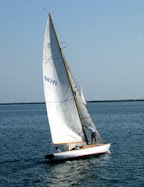
Since we sail Bolero engineless the most import feature of our modified Shields is her sail plan and our ability to alter the amount of sail that we have up as the conditions warrant. In fact one of the main reasons we selected the Shields as our conversion candidate was her fractional rig and her abundant sail area.

Even though the standard sail plan for the Shields class sailboats has a exceptional SA/D ratio of 21, I have been on the lookout for a way to add additional sail area for really light air. So when I stumbled on a new free flying drifter/Code 0 headsail on eBay last winter for less than $300 I took a chance and snapped it up.

Prior to purchasing it, I quickly drew it up to make sure it would fit and to check the location of the sheet leads.


For this sail it looked like the proper lead location would intersect our oar lock sockets and my hope was to find a way to use these hard points as an attach point for the turning blocks. In addition, with an area of 210 sq ft and an overlap of 180%, this looks to be a very nice increase in sail area for Bolero bring her SA/D ratio to 25.

Unfortunately, I decided to over think the installation. I figured that it would be sweet if the drifter was on a furler in front of the headstay. So I picked up all the necessary hardware only to figure out after stepping the mast that there just wasn't enough room between the spinnaker halyard the forestay for the drifter to furl. At least I didn't drill any holes


As it turns out this mis-step was a blessing. I ended up flying the drifter on the jib halyard with a small pennant so it would clear the jib. This allowed us to tack which we ended up doing quite often and made this sail much versatile.


This free flying drifter quickly became my favorite sail. It was quick and easy to launch and stow from its turtle bag without any need of a furler or spinnaker sock and it made sailing in really light air very delightful. And even though we are quite spoiled short tacking into our channel with our non-overlapping working jib, It was still pretty easy to short tack with this 180% drifter.

To my way of thinking sail area is safety and piece of mind for the engineless sailor. Often the engineless sailor is presented with all the things that they can't safely do without an engine. But I feel that each boats "safe" sailing envelope is dependent on how much speed and maneuverability they can generate from their sail plan in a given wind. Obviously if you don't have enough sail area with respect to your boat's displacement then you have transition to a motorboat. And in that event your motor is your only form of propulsion and is required for safety.

My goal has always been to outfit my boats so they sail in the widest possible wind range. And with the addition of this drifter the term "no wind" has a whole new meaning.

Friday, May 14, 2010

Engineless Sailing Safety Poll

Some time ago, during the epic engineless sailing thread over at the Wooden Boat Forum, I created a poll to see what folks thought about the safety of engineless sailing. Results trickled in little by little but today we reached 100 votes. So I thought I would pass along the results.


The results of this poll ended up being quite a surprise to me. Granted, my little blog is a very small and unique subset of the general sailing public, but having read all the safety concerns and fears about sailing without an engine, I thought the results would have been more much tilted towards engineless sailing being unsafe. In the end, only 9% of the visitors, and voters, from Knockabout Sloops thought engineless sailing was unsafe.

Cool.

Wednesday, January 27, 2010

Anchoring Under Sail

As this is one of the sailing skills that I have chosen to enhance and seeing as my past experiences have been lacking I thought I would add some thoughts on anchoring under sail  from Jay FitzGerald's book Wind and Tide. Jay generously granted me permission to reprint some of his writing and as I reread his thoughts on anchoring under sail I realize that I am not stealing from him nearly often enough (you can read his take on sculling oars here).

I think it is also good to set a hook at some speed of travel. Mostly you see people motor up, plop the thing, and back up. You've read about boats doing that sort of thing under sail---but there are many books like that where guys gas about traditional sailing techniques and (they read them somewhere) don't know beans about it. While on a large vessel of say 60 feet or so might be able to drop a hook and back under sail reasonably, or a square rigger might---a small sailing yacht isn't likely to generate enough power backing to even pull the chain shot straight let alone set the hook. I like to set the hook sailing at a a couple of knots and surge the thing in good and hard. Often times, under the main alone I'll come into a harbor with the rode flaked out on the foredeck ready to run. If it's tight or tricky, I'll lead the chain shot back to the cockpit, but not too often does this prove necessary. If I'm going to anchor, in say, 30 feet, I'll have that ready to go and as I approach where I want to set I'll drop the hook over the side and hold it at about 6 fathoms---keep sailing; as soon as I feel it bump the first time I'll let the whole works go. It pays out with alacrity, I head to the foredeck and as I reach that 4 to 1, I'll take a turn around the bow cleat and surge the boat to a stop. That rode will go taut, the boat will spin around and there I be, set and head to wind. Very slick and fast, and unnerving to everyone else in the anchorage. Don't be panicky about this---three knots is fast but not too fast, as long as one knows how to handle lines there shouldn't be a problem. Likely, even if the hook fouls or fails to set it will still pretty much stop the boat, but not with a surge, so take note, haul the hook aboard, sail out to weather and give it another go. No big deal, you likely just got a big haul of kelp---still, that will spin the boat around. You won't make the beach in any event.
You can do this to weather, as well, if you feel the need. When the rode fetches up you can spin around and try to screw it in the other direction as well. I think a Bruce sets easier with a semi-rotary pull that a straight linear pull anyhow. I can't really validate that but if you look at the flukes you can see why it might. Not a big problem, again, as long as the hook is reasonable heavy.
It is hard to get the feel for a set hook until one has done a bit of anchoring---so I usually suggest a different technique for a novice or myself if I'm expecting a heck of a blow and really want to be certain about my holding.
Sail up to where you want to swing from and drop your primary hook. Do this under the main alone, especially if by oneself, to keep the foredeck clear and so when you let go of the tiller and have the mainsheet sheeted in as far as it will go, your boat will round up and stall nice and easy. Your boat won't do that? Sell it; it's a dog.
Make sure the anchor hits the bottom first and you pay the chain back in a straight line as the boat starts to get sternway. This is the trick, making sure you haven't go wraps around things. If you just dump it in a pile it is quite likely that things will foul up. Better let things tug a bit, You'll start wiggling the hook in. If the wind is really roaring you might just go ahead and accidentally set it. That's OK. We'll confirm the set.
Let's say you feel it starting to grab. Go ahead and pay our a lot of rode in highly antisocial fashion. You aren't going to swing like this so don't sweat it. Pay out to about an 8 to 1. You'll see why in a moment. Don't know how much rode you've paid out? A clever hint---stitch roman numerals on your rode at one fathom intervals. then your' know.
At an 8 to 1? Drop the little kedge over the stern, and haul on the bow. Bring our self back up to a 4 to 1. Now you've go a 4 to 1 on both, right?
Take the kedge rode to a sheet winch and haul it bar taut.
Have a beer and watch it for about 15 minutes. Does it stay taut?
Does it slowly, slowly go slack? You're dragging, and if you would have tried this with an engine you never would have known, would you? Feel smug. If you need to , haul the kedge and try again. You'll get a bottom sample when you do; if all you get is a big blob of kelp you'll learn something as well. Move.
Now you've got options. Put the main away while you think about it, as you're going nowhere.
I do, a lot of times, leave both of them down, and I take care to set myself pointing into the direction of wave or wind action. A boat rides very nice like this, but if I've likely go a pretty good current running at some point I might not. Depends. It is often a good idea to keep the bow pointed into the direction of incoming powerboat wakes. Sometimes it's since to pull the kedge and get a couple of chowder clams. At any rate, this technique allows a sailor to really feel a set, and he will sleep better for it. I really recommend making a habit of it, at least until one is comfortable with the anchoring game.
Again, an anchor's hold is primarily determined by its angle of bite to the bottom. This of course is the purpose of scope but can be greatly increased by a heavy chain rode. As I said, if one seldom needs a heavy chain rode but on occasion needs that short scope, a 20 pound or so mushroom anchor can be shackled to the head of the chain rode to act as a sentinel and will greatly increase the holding power of the ground tackle. This is especially useful in and anchorage that is experiencing a good deal of surge, or if one is anchored on a weather shore being set into deeper water.

Rereading Jay's writing is a good shove to get me past the complacency that has set in during the past 5 or so years that I have been reaquainting myself with sailing. Hopefully this time next year I can discuss this topic with some experiences of my own.

Friday, January 8, 2010

Is Engineless Sailing Safe?

There is a pretty lively discussion going on over at the Wooden Boat forum on Engineless sailing and cruising in the thread Sailing With No Engine?. These types of discussions come up occasionally on various forums but this one has stayed pretty focused on choosing whether or not to have an engine on a sailboat on why or why not.

Some threads on other forums have quickly diverged into discussions on auxiliary propulsion systems, outboards etc. But this Wooden Boat forum thread has pretty much come down to safety with some seemingly believing that it is unsafe and discourteous to sail engineless and other believing that with proper skill, patience and seamanship it is completely safe.

Having read through and participated in the 200 plus post Wooden Boat forum thread I am curious what others think. So I added a poll concerning the safety of sailing engineless to the sidebar of this blog.

I would greatly appreciate it y'all would take the time to vote.

Thursday, December 31, 2009

Engineless Sailing & Knockabout Sloops (Repost)

This is a repost of a post that I made just over two years ago. I reviewed it again as I was rereading old posts. My inspiration for digging through the archives was an engineless sailing thread (Sailing With No Engine?) that had come up over on the Wooden Boat forum.

As I reread this post and the Wooded Boat forum thread I found that virtually nothing has change with respect to why I sail without an engine. And even though I can pretty easily get drawn into the engine vs no engine debate my heart really isn't in it as I have no real interest in "converting" anyone to sail engineless. It is just a choice and just as viable as any other.

My only wish is that every boater, no matter how they chose to boat, was so delighted and at ease with their own choice that they didn't need to denigrate other choices to justify their own.


Engineless Sailing & Knockabout Sloops

I have mentioned many reasons behind my quest for a modern Knockabout Sloop. But I have not talked about the most import one and the main reason that I have gone to such an effort to create such a unique sailboat. This reason is that I choose to sail without the aid of an auxiliary engine. Modifying an old race boat to use as a daysailor / weekender meets my needs for aesthetic beauty and sailing performance.

The purpose of this post is to explain why this choice is important to me, what it has got to do with Knockabout Sloops and to provide some information and inspiration for others who might desire to make a similar choice.

My passion for sailboats is all about sailing. I admit that the destination is not nearly as important to me as being out on the water sailing. So I guess it was natural that I choose to own sailboats without engines.

I would say that if one wants to sail an engineless sail boat you need three thing.
Attitude

A Thick Skin

An Excellent Sailing Craft


Why these three things you ask. Well let's go down the list one at a time.

Attitude - You will definitely need an attitude that you can sail engineless. You will be trading the convenience of motor sailing for the challenge of honing your sailing skills. You and your sailing skills will be completely responsible for where you can go and when you get there. It will be your sailing skill that gets you back to your mooring or into your slip. There will never be a guarantees that you will arrive home the same day you set out even for a day sail. Mostly you will succeed but again there is no guarantee. So you need an attitude that relishes challenge and an attitude that is flexible.

I feel that the rewards are immense. One of the things that I hear occasionally from other boaters is "I could sail up to my mooring if I wanted to, I just motor because I am in a hurry". I won't argue that point one way or another. What I know from personal experience is that when all you have is your sails, unless your are rowing, you always sail up to your mooring. And surprisingly enough, not matter how many times I do it, there are times when it is not as simple as I expected. Each time is a new learning experience. By sailing you will always "get" to take advantage of these learning experiences.

A Thick Skin - Other boaters will present you with countless reasons why you can't possibly sail without an engine. Or they will tell you that it is unsafe. You will be "offered" suggestions about how much better your sailboat would be if you added an engine. Or how you could fit and outboard or a small electric on that transom.

All of these arguments are just about choice. All of the challenges can be overcome with skill, preparation and thoughtful sailing. So you will need a thick skin and a strong ideal around some other boaters. Don't get me wrong, most other boaters have been very supportive of my engineless sailing. But some get defensive and feel that I am just showing off or trying to prove something. I am not and you won't be either. There was a time when sailing without an engine wasn't proving anything, it was just sailing. So my advise is to keep a low profile. One of my early mistakes was that I got too excited. So, of course, I wanted to tell anyone who would listen or not how wonderful and possible it was to sail engineless. This was a mistake. What I know now is that if someone is interested they will seek the information they need.

An Excellent Sailing Craft - In our modern world this may be the most difficult part of sailing engineless. Modern sailboats are rightfully called "Auxiliary Sailboats". This means that they need their auxiliary engines some of the time. Many need them most of the time. My goal for an engineless sailboat is to maximize the conditions in which I can sail. For me this means a smart sailing boat with plenty of sail area. I feel that most modern cruising sailboats just don't have enough sail area. Often times they also have a great deal of added windage in the form of radars, mast steps, roller furling, high cabin tops etc. What this means for engineless sailing is this: In light wind they are woefully under canvased and in heavy wind they have too much windage. This makes sailing in really light air almost impossible and makes it more difficult to fight off a lee shore in the heavy stuff. So what this does is minimized the wind range that they can sail in. Just the opposite of what I am looking for in a sailboat.

So if you truly want to sail engineless remember that everything is a compromise. You have to ask yourself what you are willing to do to sail more. That is the question. Since I don't have an engine I row when there isn't enough wind. So while I am rowing I get lots of chances to think about what I could give up or add so I can sail instead.


Resources - The following resource have greatly helped me developed the confidence and skills that have served me in my pursuit of engineless sailing.
Lin and Larry Pardey - Lin and Larry planted the original seed of sailing without an engine. They simply sailed around the world for years without an engine. They help me see that it was and is possible and also rewarding.

They have documented much of their journey in their many books. Two in particular I reference often "The Capable Cruiser" and "The Self-Sufficient Sailor". Combine this with "Cruising in Seraffyn" for inspiration and you will be all set.

Lin and Larry Pardey
 The Capable CruiserThe Capable Cruiser
Classic manual for hands-on sailors. Discusses what every cruising sailor needs to know: preparation, maintenance at sea, safety aloft, seamanship, staying healthy. Lots of clear photos, illustrations.

1995, 400 pages


Self-Sufficient SailorSelf-Sufficient Sailor

Full of ideas and wisdom on how to sail in comfort and safety without large cash outlays. Every sailor, whether or not they plan to sail over the horizon, should read the Pardeys.

1997, 320 pages


Jay Fitzgerald
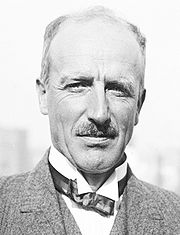
Jerome (Jay) Fitzgerald started the Oar Club out Bellingham, Washington with the follow mission:

The Oar Club is dedicated to those who sail and appreciate the beauty inherent in sailing. The oar Club is dedicated as well to promoting the skill, character, and seamanship displayed by those who sail in its traditional fashion--without the aid of engines. The Oar club affirms the rigors of true sailing--the attentiveness they demand and the strength they contest--as rewards: This is what makes the experience meaningful. We cannot imagine demeaning our experience by making it trivial or common. That does not mean that we demand that we cross oceans (though some do) or rashly brave storms (though some have) bur rather that we do what we do, in a manner real and meaningful, and eschew that which is not. Perhaps fifty percent of seamanship occurs within fifty feet of a dock...
His two books, "Wind and Tide, An Introduction to Cruising in Pure Sailing Craft" and "Sailing with Purpose, The Pursuit of the Dream" were my first introduction to engineless sailing. At the time I didn't know of anyone sailing engineless in the Pacific Northwest so in that respect his books were invaluable.
A sort of sailing book that is seldom seen anymore, Wind and Tideis more concerned with the necessary skills and techniques involved in sailing than the gear. A must have for any that desire to voyage under sail.

Paperback
6 x 9
168 Pages


Sailing with Purpose: The pursuit of the dreamSailing with Purpose: The pursuit of the dream
A quirky philosophical work written with the express intent of encouraging men to go to sea to seek their fortune. A sailing book, blending philosophy, archetype, crude irreverance, and the need to sail. . .

Paperback
6 x 9
148 Pages


Neither of these books are professionally edited and they both contain grammatical and typographic errors. Many readers offend by Jay's passion, strong opinions and judgments use these errors to dismiss his books. I say give one of them a read. If Jay's message appeals to you, you will see past the writing flaws and take what knowledge and inspiration you need to become an engineless sailor.
One last thing I often here is that it might be okay to sail engineless where you sail but in our area (name your area) we have a lot of calm days. I bring this up again because I live in one of those areas, the Puget Sound. And again, it is all about choice. Choose a great sailing boat and set it up with a flexible sail plan. Focus more on you light air sails than on your storm canvas as we are talking coastal sailing here. Rather than give up and say there isn't enough wind use the opportunity to challenge yourself to find a way to get more out of the wind that is around you. Sure there will be calm days. But change your own definition of what constitutes a calm. For some boats a calm is 5-7-10 kts other boats, hopefully yours, can be doing 5 kts at 6 kts true wind and still be sailing with even less.

Like the Aphrodite 101


Wednesday, December 30, 2009

2009 Sailing Report Card

Way back in April I came up with a list of goals with the intent to improve my sailing skills. They looked something like this:

  • Sail Trim - The straight skinny is that I know the basics of sail trim and on a scale of 1 to 10 might give myself a 6. My old boat didn't have much in the way of sail trim controls but Bolero has almost all of them. And my lack of knowledge of these new tools is readily apparent. My improvement plan consists of two parts. First study like hell. There is no shortage of great info on sail trim and I have more than enough references. But second I am thinking about getting some on the water training. For some reason, Lopez Island island is a mecca for great sailors. World champion in this class. Or an America's Cup sailor, or North Sails guru. The list is quite long. So I am hopefull that after a bunch of studying I can coerce, pay or kidnap someone to come on the water with me and set me straight.

  • Casting off the Mooring - There is almost nothing that I really like about my casting off procedure. Neither Bolero or my old Bluenose really liked to point into the wind and they will try to start sailing when the mainsail is about half way up. Currently it is a bit of a circus of raising the main and going aft to untangle the main sheet or correct the tiller to keep the boat into the wind all the while trying not to run over the mooring and then back to the mast to finish raising the mainsail. Then I quickly raise the jib, back wind it to fall off away from the mooring and cast off. Okay it isn't always bad. Sometimes it goes very smooth. But I want a better more controlled procedure. One that works in really light air (which is often worse) and heavy air.

  • Picking up a Mooring - Not surprisingly, I do this as much or more than casting off my mooring (I actually practice this one). I am pretty good at it. But still there are times when I suck at it. And there really is no excuse for doing something so often and doing it poorly. No matter what my success ratio is. So I am going to try to find out why it can get messy and fix my procedure. I am also going to really, really learn about the amount of way Bolero makes under various speeds. Which means I need to learn, without electronics, how fast she is going.

  • Reefing - I think it was Rod Stephens who said something to the effect "that if you can't reef in less than a minute either your system is wrong or your skills are poor". Enough said. My goal is to really streamline my reefing system and skills.

  • Docking - The further down this list we get the worse my skills. I dock three or four times per year. Mostly as a result of launching and hauling out. I have, knock on wood, been pretty successful with this. But there is not way I can attribute this to skill. All of my docking has been into the wind or a beam wind coming off the dock without much boat traffic. So this will also be the year of docking practice. We have plenty of docks situated in every possible orientation to the wind. This will really be boring.

  • Anchoring Under Sail - I have done this twice. There, I said it. No experience at all. Plenty of reading and my plan will be completely stolen from Jay's books. Bolero is really my first boat with a permanent anchor system and the ability to spend the night away from the mooring.

I thought that it might be beneficial to have a post season look back at this list to see how I did. Maybe grade my efforts.


Sail Trim - Grade C

I did spend a fair bit of time this winter and spring honing up on my sail trim theory. In addition I actually tuned Bolero's rig to the class specifications. And once we were launched I used her sail and rigging trim systems far more often and with better results than I ever have on any boat that I have owned. I particularly used the backstay, outhaul, halyards to power and depower the rig with fine results. But I never did manage to get one of our local sailing experts on board to school me and I still feel like I don't know squat about sailing a Shields or the nuances of sail trim.

Casting off the Mooring - Grade B

This simple and often occurring task went very well this season. I kind of laugh just thinking it is on this list. I mean just how hard can it be to cast off of a mooring? Boats do it all the time without any help at all. But Bolero, and my Bluenose before, love to sail and they point well. So pretty much as soon as the main goes up they want to sail. And since I like to have a balanced sail plan prior to casting off I need to hang out on the mooring long enough to get the main and the jib up. This had been quite problematic in the past. But this year we pretty much licked it by using the topping lift to depower the main and keeping the main sheeted in. This way Bolero stayed pointed into the wind until we back winded the jib and cast off. Pretty easy.

Picking up a Mooring - Grade - C

Picking up the mooring continued to challenge me all through the season. It started off pretty bad and got consistently better but with some nagging relapses about every time I thought I had it nailed. I still need to get a better handle on sailing slow and how much way Bolero will carry at various speeds and wind conditions.

Reefing - Grade - B
Reefing was definitely our best effort of the season. I installed and tweaked a reefing system that I quite liked and that worked very well. In addition the wind almost always seems stronger as it funnels through the anchorage so I decided to always tuck in a reef prior to sailing into the bay unless the wind is very light. This means we reefed a bunch. I can reef quickly and easily single handed. And I have a slight additional tweak for next season that should make reefing even a bit quicker.

Docking - Grade - Incomplete
We docked under sail exactly one this season. Just a practice run, docking in light air and we still manage a poor attempt.

Anchoring Under Sail - Grade - Incomplete

Another lack luster attempt as we didn't work on this skill at all.

Navigation & Situational Awareness - Grade - F
Okay, I know this wasn't on my list but since I cleverly managed to run Bolero up on the Yellow Island Reef at 4 kts  it definitely should have been.
Overall pretty poor marks for a summer where I spent the better part of 125 hours at the helm. Especially since I sail engineless and I am committed to sail and maneuver every where that I want to go. So it looks like I have to continue to force myself to enhance my skills in addition to going out for lovely daysails.

Tuesday, August 25, 2009

An Inspiring Piece of Sailing

We usually scull using the rudder to move from the travel lift to the dock. Then we rig up the backstay and sail off.

We are definitely not worthy.


Quite a nice piece of seamanship.

Friday, July 24, 2009

Thursday - July 23 - I Guess Sailboats Don't Have the Right of Way (9 NM)

For the very first time in my sailing life I asserted my right of way rules over a power boat. Normally I work very hard to stay clear and give room. But this time I was hemmed in a bit and needed to maintain my course. His response was "why do you have to sail here you dumb ass". Being that his was one of those big multi-story type power boats and that he was coming right at me, I yielded to avoid a possible collision.

At the time I was just inside of the 2 fathom line at a +2.8 ft tide on the West edge of the channel. I had left the entire 140 ft wide deep center portion of the channel open for this large vessel. But for some reason he needed to head straight at me and swear at me for sailing.


Finally I was forced to give way and head into the main part of the channel. This correction put me in exactly the place I was trying to avoid, the crowed center of the channel, so I elected to abort my exit due to an additional two vessel heading in. Both of these vessels would have passed harmlessly by me as I sailed along the 2 fathom line as is the case day in and day out.

I guess in our modern world the nautical right of way rules have reverted to the more time honored rules of:
Sizer matters
and
Those with the gold make the rules
In any event this skippers cursing and swearing at me for sailing pretty much ruined the mood and a nice day. I still worry that a day will come when enough people like this get together and ban sailing in my home bay.

I do need to add that most boaters are very, very respectful of others and of us sailing. It is just ironic that when I needed a right of way I ran into this skipper.

July 23 Tides - Friday Harbor


July 23 GPS Track


2009 Sailing Summary
Sailing Days-24 / 79 (29%)
Blissful Hours of Hand Steering - 2:10 hours today & 78:05 hours for the season
Total Miles Under Sailed this Season - 294 NM

Saturday, May 30, 2009

Is Being Rescued Our Right?

Yesterday I started out reading a post from Capt. Richard J. Rodriguez over at BitterEnd about planning and situation awareness. From there I read an article by Roger Taylor titled "Safety at Sea - A Radical Approach" (this is a really, really good article).

It is my opinion that it is a very selfish choice to outfit a boat with "safety" devices that require someone else to risk their life at my own expense. Roger Taylor's article really sums up this idea that it is our right to be rescued.

At the same time we are increasingly vociferous about our 'rights'. We all have a million and one 'rights' to just about everything you care to name: food, shelter, good jobs, pensions, education, televisions, whatever. You name it, we have a 'right' to it. We are now so habituated to assuming our 'rights' that, I am sure, many ocean going sailors also assume the 'right' to be rescued, should they hit trouble, without a second's reflection or hesitation
And a bit later on in the article

An assumption of the right to be rescued is a poor starting point for the ocean sailor. It is my view that much of modern so-called 'safety' equipment, in particular the Emergency Position Indicating Rescue Beacon - the EPIRB - insidiously militates against the proper preparation of yachts and their crews for ocean sailing. Its unspoken message is that at the press of a button help will be on its way. It is the ultimate safety net. It should not be. The ultimate safety net should be the uncompromising preparation and seaworthiness of the yacht to be sailed, and the proper mental attitude of its crew. My point here is that a good proportion of the effort and expense of fitting out a yacht for the sea these days goes into gadgets perceived as 'safety' equipment - EPIRBs, radios, satellite telephones, in other words equipment designed to help the sailor communicate his plight
I contend that assuming the right to be rescued is a poor starting point for any sailer. And I went sailing today with much of this information on my mind.

As we sailed along, monitoring channel 16 as always, we heard the normal amount of requests for aid. Fortunately no Maydays today but those occurrences will unfortunately increase as the busy summer season kicks in. Most of the calls are and will be engine related from boats drifting with the current and needing a tow. As we sailed along we tried to think about what could happen to us that would cause us to send out a Mayday call. The first thing that came to mind was an accident. The two big "fears" in our area our "deadheads" (submerged floating logs) and being hit by a boat under power. Neither of these two are really big fears for us. We really, really keep a lookout for flotsam and we sail very defensively.

We also thought about what we would do if we lost our mast, or if the wind completely died and we were drifting with the current (which actually isn't that rare for us). But always we came up with a number of ideas that would prevent us from "needing" to get rescued.

I have always sailed with the idea that the risk is all mind. I don't really think there is that much risk as we have a very sound boat but in the end if I really screw up I pay the ultimate price. That being losing my life. In some ways the myriad of "safety" device is sort of panacea that provides an unrealistic sense of security.

One of our rules of sailing is the 50-50-50 rule. If we are 50 yards from shore and the water is 50 degrees we have about a 50% chance of making it to shore. Our season is from early May til late October. In the extreme edges of our sailing season we are often the only boat for miles around. The simple fact is that if we go into the water we die. Safety devices like EPIRB's and even life vests will just make it easier to find and recover our bodies.

This fact was really brought home to me when I took a sailing instructors class during May at Port Townsend. I ended up deciding that being US Sailing instructor wasn't my gig but not before "getting" to perform the safety swim test. We had to swim something like 25 yards, fully clothed, out to our instructor's boat, tie a bowline around our waste, put on our life vest and swim back to the dock. Let's just start by saying I don't ever want to do that again. In my judgment if the distance had been double I doubt everyone in our class would have made it. Even so, A number of participants needed assistance climbing up onto the swim platform on the dock which isn't close to what it would take to scramble back onto a boat. I would say that anyone boating in the Puget Sound should perform their own, supervised, swim test to figure out their own safety limits. And of course find a way to stay in their boat.

The sad fact, for me, about this topic is the boating regulations that will obviously follow as a result of the lack of ownership for our responsibility as "Captains" of our own vessels. If we can't demonstrate competency by continually needing the "safety net" of rescue the powers that be will try to regulate "competency ". Boy won't boating be fun then.

Sailing is Work, Sometimes Hard Work

My wife and I are in our late 40's and we have come to an obvious conclusion. Sailing is work. Sometimes it is hard work. Pretty much any day that we go sailing we come home tired. We sleep really well that night and can be a bit sore the next day.

For us, it is work we quite enjoy. We both really like the short tacking it takes to get back into our bay and the feeling of accomplishment that goes with it. As we get older, this may change but for now we love it.

The whole idea reminded of going backpacking for the first, and only time, when I was twenty five. I went with a bunch of my co-workers who were in their 50's. I hated every minute of it. It was way too much work for me to carry all the food I wanted to eat on my back.

Turns out it just wasn't my kind of work.

This idea got me thinking about why other people boat. I have often participated in the engine verse engineless debate, or discussed roller furling and other conveniences offered to boaters. But I wonder if doesn't boil down to deciding how much work each of us are willing to let sailing be.

If adding conveniences to a sailboat is a result of wanting it to be less work, I can understand that choice.

Friday, May 29, 2009

A Good Reminder About Planning

Capt. Richard J. Rodriguez over at BitterEnd has a great post about planning and situation awareness. Very much worth the read.

Sunday, April 5, 2009

My Summer Goal - Becoming a More Proficient Sailor

One of the biggest problems that I have due to my love of sailing is that I don't practice enough. When the wind is nice and I am on a great close hauled course, I could sail that way for ever. But, sailing isn't really about nice close hauled courses (well maybe it is, but there are other important skills). It is about maneuvers, like docking, reefing, picking up a mooring, anchoring etc.

I was reminded of this last week when Jay FitzGerald stopped by and made a quick, pointed comment to my blog.

Hi Bill, it Jay.

Beautiful boat, I know your harbor and it looks like a lot of fun.

Too much power in the headsail and not enough in the main. You need a blade jib and a powerful vang.

Anyway.
It would be easy to pat myself on the back and focus and the first sentence but the wisdom was in the second. In many way I am a bit of a hack. Lacking in some of the required nuances of sailing technique. So my summer goal is to work to develop and enhance my sailing skills.

Specifically
  • Sail Trim - The straight skinny is that I know the basics of sail trim and on a scale of 1 to 10 might give myself a 6. My old boat didn't have much in the way of sail trim controls but Bolero has almost all of them. And my lack of knowledge of these new tools is readily apparent. My improvement plan consists of two parts. First study like hell. There is no shortage of great info on sail trim and I have more than enough references. But second I am thinking about getting some on the water training. For some reason, Lopez Island island is a mecca for great sailors. World champion in this class. Or an America's Cup sailor, or North Sails guru. The list is quite long. So I am hopefull that after a bunch of studying I can coerce, pay or kidnap someone to come on the water with me and set me straight.

  • Casting off the Mooring - There is almost nothing that I really like about my casting off procedure. Neither Bolero or my old Bluenose really liked to point into the wind and they will try to start sailing when the mainsail is about half way up. Currently it is a bit of a circus of raising the main and going aft to untangle the main sheet or correct the tiller to keep the boat into the wind all the while trying not to run over the mooring and then back to the mast to finish raising the mainsail. Then I quickly raise the jib, back wind it to fall off away from the mooring and cast off. Okay it isn't always bad. Sometimes it goes very smooth. But I want a better more controlled procedure. One that works in really light air (which is often worse) and heavy air.

  • Picking up a Mooring - Not surprisingly, I do this as much or more than casting off my mooring (I actually practice this one). I am pretty good at it. But still there are times when I suck at it. And there really is no excuse for doing something so often and doing it poorly. No matter what my success ratio is. So I am going to try to find out why it can get messy and fix my procedure. I am also going to really, really learn about the amount of way Bolero makes under various speeds. Which means I need to learn, without electronics, how fast she is going.

  • Reefing - I think it was Rod Stephens who said something to the effect "that if you can't reef in less than a minute either your system is wrong or your skills are poor". Enough said. My goal is to really streamline my reefing system and skills.

  • Docking - The further down this list we get the worse my skills. I dock three or four times per year. Mostly as a result of launching and hauling out. I have, knock on wood, been pretty successful with this. But there is not way I can attribute this to skill. All of my docking has been into the wind or a beam wind coming off the dock without much boat traffic. So this will also be the year of docking practice. We have plenty of docks situated in every possible orientation to the wind. This will really be boring.

  • Anchoring Under Sail - I have done this twice. There, I said it. No experience at all. Plenty of reading and my plan will be completely stolen from Jay's books. Bolero is really my first boat with a permanent anchor system and the ability to spend the night away from the mooring.
Well this should make for a full summer, and then some, of sailing.

Saturday, April 4, 2009

The End of My Beauty and Engineless Sailing Rants

One of the things that I have noticed about in writing, and ranting, about my sailing ideals is how pointless it all seems. I seem to be championing an ideal of engineless sailing and beauty that is long gone. Buried in a sea of plastic, diesel and electronics. What I know is that the effort on my part takes time and energy and is seldom well received. So I have decided to stop ranting on Knockabout Sloops. If the need should arise perhaps I will rant on my forum, which is pretty much my own private space.

The world is ever changing and I wouldn't be surprised if engines became a legislated "safety device" or if more harbors required them to enter and exit (I believe Victoria BC already does). Therefore I will endeavor to seek out beauty under sail, while I can, instead of pointless rants.

It is a good time, what with sailing season just about to start in the San Juan Islands.

Tuesday, March 10, 2009

I Welcome Comments

I very much welcome comments to this blog. In fact I am given the choice of publishing or rejecting them and I publish them all. I just received this comment from Kevin about my recent rant about The Engine as a Safety Device.

Kevin said...

In general I appreciate where you seem to be coming from with your blog. I've done a ton of sailing on boats without an engine, though I currently have a 32' boat with one (and plan to keep it). I do agree that far too many sailors lack basic boat handling skills and the engine is a crutch for them.

That said, I don't really get the point of this particular post. Are you advocating that sailboats shouldn't have engines? Or that using one is a copout? Would you really like to see the chaos that would ensue in marinas and small bodies of water with lots of boats?

I'm just not sure what you're driving at (other than pressing your acknowledged point about being an engineless sailing snob).

Point taken, I guess.

Good luck with your blog.

Let's start with the end first. That is, me as an engineless sailing snob. Just to be sure I looked up snob in the dictionary.
snob: a person who feels and acts smugly superior about his particular tastes or interests
I imagine, quite fairly, that this definition could very well be applied to me. Personally I feel more passionate than snobbish but of course my view is tainted. I would like to think that my rants don't originate from a feeling of superiority but from a feeling of frustration. Time and time again when the case of sailing engineless is presented, it is met with countless reasons why it is unsafe or irresponsible to not have an engine onboard. This post was my attempt to reinforce the fact that an engine is not a cure all and doesn't replace skill.

Here are the rest of Kevin's questions and my thoughts.
Are you advocating that sailboats shouldn't have engines?
Actually sailboats haven't had engines for 1000s of years and still don't. Motorsailors do have engines. All I am advocating is that there is a difference between sailboats and motorsailors. And there is a difference is skill set required to operate each one.
Or that using one is a copout?
I absolutely don't think operating any boat is a copout. Unless you do one thing and say another. For instance it would be a copout if I claimed to hike Mt Rainier if I rode up on a mule. I do think it is irresponsible to skipper a motorsailor without the skills required to operate it should the engine die.
Would you really like to see the chaos that would ensue in marinas and small bodies of water with lots of boats?
I want to say of course not. But then I live in the San Juan Islands and we actually do get a fair bit of chaos at the marinas on Lopez during the busy part of the summer. And so apparently do the vessel assist people. Which was part of the point of my post.
I do agree that far too many sailors lack basic boat handling skills and the engine is a crutch for them.
This really was the whole point of my The Engine as a Safety Device post. It wouldn't be the first time that my passionate ranting distorted my ideals. Perhaps I should sit on these posts overnight before I post them.

Cheers and Thanks for your comment,

Bill

Saturday, January 17, 2009

The Engine as a Safety Device

Update - Capt Richard J Rodriguez checked in and commented on this post. A man who doesn't mince words.

WTF indeed,

Most sailboats don't require an engine. Many sailors do.

I have mention many times before how frustrating it can be talking about sailing in an engine world. To often the debate turns to safety. As if this is the trump card that proves all sailboats "need" engines. Anecdotally this idea has never seemed to bear fruit for me. Many of the cruising book that I have read talk about a major engine failure in some far away port and the hassles of getting it fixed. Many talk about tossing the bloody thing right over the side and being rid of. In my local cruising area, the San Juan Islands, on any given weekend summer day you hear a couple of vessel assist call dealing with an engine failure. Many from sailboats on beautiful, windy days.

Capt Richard J Rodriguez in his blog BitterEnd had a post from the July 4th week in 2007 that added some numbers to my anecdotal experience. Capt Rodriguez is a rescue tug operator that answers Vessel Assist call in the San Juan Islands. Here is an excerpt from his blog.
Here are the top five reasons why over 3,500 boaters have been helped by TowBoatUS and Vessel Assist this week:
  1. General engine failure: 57% of cases
  2. Battery jumps / electrical: 15% of cases
  3. Out of fuel or fuel problems: 10% of cases
  4. Soft Grounding: 10% of cases
  5. Outdrive / Overheating: 8% of cases
Now the math in this confuses me a bit as he calls these reasons the top 5 but his percentages add up to 100%. In any case this would indicated that a major source of business for Vessel Assist is engine failure or complications of the engine system.

WTF!

What kind of marketing hype could possibly convince the general public that engines are a safety device in sailboats? How can a device that actually requires you to be rescued be considered a safety device?

Here is the rest of Capt Rodriguez's post
These give more reason to keep a regular engine maintenance plan similar to your car, obtain and know your current charts and never trust your gauges 100%. Did you know that an average on-the-water tow can cost up to $200/per hr? The clock starts ticking from the time the towboat leaves his port and returns home. If it takes a total of three hours, your bill is $600. If you have a soft ungrounding, it may be over $900. With a basic BoatUS Membership we will pay the first $50 which leaves you with $550+ to pay. That's why we recommend upgrading to a higher level. BoatUS offers the largest nationwide fleet with over 500 towboats and 280 ports. We will help you with anything from soft ungroundings to fuel delivery. Please visit BoatUS.com/Towing/ to see what service level is best for you
Kind of an add for BoatUS towing service. But what I liked was one of the comments on this post from his blog.
I agree. Much cheaper to buy insurance than constant worrying about a 20 year old power plant. I have spent hundreds of dollars improving my motor's reliability but you never know where that deadhead will be or when you will suck up a piece of plastic in your cooling intakes! I feel alot better knowing I have a backup plan other than the coast guard or fellow boaters.
So let's see if I have this straight. A sailboat must have an engine for safety sake. But an engine can be unreliable at unexpected times. Therefore get towing insurance to cover the ass of your safety device.

I have posted this video before


But I think it should be a constant reminder of the risk of putting the safety of your boat and your lives on an engine alone.

Sunday, January 4, 2009

Motor Sailing

I am catching up from a three week holiday that included a 10 day Caribbean "cruise" on the Celebrity Constellation. This was a gift to my parents for their 50th wedding adversary so in that respect it was a roaring success. But it was neither a cruise nor a visit to the Caribbean by my definition. For the most part it was a trip from one manicured cruise ship terminal, and their duty free shops, to the next. The onboard life seemed to revolve around over-eating ordinary food and more duty free shopping. Obviously, not my cup of tea.

I found it interesting that cruise ships still like to use the words "set sail" as a description for the start of their journeys.

As I was catching up on my email and reading, engines and sailing seemed to be a new year theme. First there was a thread from the Plastic Classic Forum on a discussion about converting a Triton into a Motor Sailer. I couldn't help but wonder how other people determine when to call a boat a Sailboat, an axillary powered Sailboat or a Motor Sailer. A quick check of the various online dictionaries didn't really clear anything up

Main Entry: motor sailer

Function: noun

Date: circa 1923
: a motorboat with sailing equipment


motor sailer

–noun Nautical.

Origin: 1930–35

a yacht having sails and an engine as an alternative or auxiliary means of propulsion.
Then, in a little random night time rereading of Jay FitzGerald's Sea-Steading, Jay in his usual bluntness gets right to the point.
Some people with more taste claim to still cruise what passes for "sailboats," although this number is dwindling in comparison to their noisy bastard cousins. "Sailing," I will insist, however, has become an activity seldom practiced. Many "cruisers" who claim to "sail" today gloat with pride if their passages make the fifty percent mark in terms of their ratio of sail miles covered to power. This ratio of fifty percent has become reasonable to many. Not only this, it has also become reasonable to expect to only sail when it is convenient, and the wind and weather are within a very narrow range of conditions. When seamanship is called for, or when speed drops below an arbitrary number -- indeed when most perform the very act of setting sail -- the engine comes on. These boats are designed, crewed and "cruised" in a manner that makes "sailing" impossible, thus they demand auxiliary power. People say it is only reasonable to have an engine on board a "sailboat." Reasonable? Since the engine removes the greater need for seamanship, for knowledge, even for personal investment, thus the resultant experience is fundamentally changed. It is reasonable to ignore the fundamental reason why one might want to sail at all?

Most people one meets are avid "motor-sailors." Most people have "motor-sailor" craft where the auxiliary engine is critical to the function of the vessel. It is necessary for propulsion, as well as for the power to drive convenience systems. It is the artificial crew that allows sail changes to be made. It is the hands that set and haul the anchor. It is the eyes that keep watch. This is obviously the case. This is indeed typical and expected.

Yet if you were to call one of these "sailors" a "motor-sailor" or refer to the boat as a "motor-sailer," as it obviously is -- by every potential definition -- most of these "motor-sailors" would bristle. They would take this as an insult.

Why should this be troublesome? Either one "sails" a "sailboat" or one does not. This is a pretty simple concept. If one "cruises" under sail -- then one is a cruising "sailor." Again, not a difficult concept. Why then do not most people freely admit they are "motor-sailors" and not "sailors?" Why do people get hot under the collar when called a "motor sailor?" Why should this be construed as an insult? Because we all recognize that it takes more skill and ability to handle a sailboat under sail than it does to handle a motor sailor, and we respect that. We recognize that it takes more investment to make passages under sail than it does under power-assisted sail. We recognize that a person who has the will, ability, skill, and stamina to do so has more will, ability, skill, and stamina than one that does not. We understand that a "sailor" is in many ways a more skilled human being than is a "motor sailor." Understanding this, many people do desire to be sailors and to sail. Unfortunately, however, many of these same people do not care to make the investment necessary, nor they do not have an interest in the amount of sweat and effort involved. Still, they desire the status of skill and so have learned to merely presume to be "sailors." They pretend. Thus the insult inherent in the term "motor sailor." It calls a spade a spade.
Anyone still reading? Jay has a knack for getting right to his point. The thing I like about Jay's writing is that he tests and pushes my philosophy of awareness without guilt. It is my way of learning and achieving. The first step in the twelve step program. So I wonder what is it that causes cruise ships to "set sail", or "sailboats" to define sailing as motoring. I am certainly not going to say one choice is better than another but some are harder and take more skill than others. Isn't that why we sail in the first place? The challenge? The reward? Well it is why I sail.

Happy New Year


Wednesday, November 19, 2008

Engineless Abundance

I had a engineless rant brewing in my mind for the last couple of days. All about how impossible it is to sail engineless. Or at least that is what I often hear. I will mention that I don't have an engine and someone will say "oh, that's great but you can't do X". If I explain how I can do X something else comes up. The cycle is endless.

Well I was already to come out a ranting when I stumbled across a new, to me, blog proafile and a post by Michael titled Power vs. Sail, Takers vs. Leavers. I really, really enjoyed reading this post and I highly recommend it. It is inspired by Daniel Quinn's book Ismael (which I also highly recommend) and the idea of the society of Takers and Leavers.

Quinn categorizes cultures into two distinct types: the "Leavers" and the "Takers". Leavers are cultures that take from the environment only what they need to survive, and leave the rest. Takers do just that - they take it all - whether they really need it or not.
Michael relates these concepts to powerboats and sailboats. First powerboats:
Powerboats represent the Taker personality. A powerboat stores up (hoards) energy in the form of diesel before a voyage. A voyage under power is all about planning - time, distance, fuel. You can know before you leave how it will turn out as long as you plan carefully. Wind and tide may not be in your favor, but if you have enough fuel and enough power, even the forces of nature will not dramatically effect the outcome. Of course, given the fracking big forces nature may throw at a boat, a powerboat can never really have "enough" range, speed or power, so there in a nutshell is the Taker dilemma: always wanting more.
And sailboats:
Sailboats are Leavers. A sailboat, by its very nature, cannot store up its motive power. It's a rare example of forced "Leaverhood". It catches the wind, and then lets it go. A wind powered vessel heads to sea carrying only the faith that the wind will be sufficient to make the passage. It doesn't know exactly how long it will take or how difficult, but it trusts that it will eventually get to where its going. That is a profound difference in attitude. A sailboat doesn't focus on limits, but on abundance. The amount of power available in the atmosphere at any time is always far, far greater than any boat can possibly use. A sailboat doesn't worry about "wasting" the wind. It doesn't parse out a meager ration, no, it only tries to catch a tiny fraction of the immense power available to meet its needs. It DOES need to be alert, or "present in the moment", if it hopes to take best advantage of the wind, but it absolutely never need worry about running out.
The line that really struck me was "A sailboat doesn't focus on limits, but on abundance". This really nailed my experience of sailing without an engine and why it is so futile to try and argue why one does it. It just isn't about what you can't do, it is about the abundance of what you can do.

Michael goes on to speak about a story of the Australian Aborigines:
I once read about the Australian Aborigines and their attitude toward the land that sustains them. They speak of the remarkable abundance of their land, and their deep felt appreciation for its bounty. This is from a people who live on the most barren continent on earth (save Antarctica).
Which is exactly how I feel about the abundance of sailing in the Pacific Northwest, an area considered by many to be barren of wind. Perhaps in our our rush to "hoard" we miss the abundance all around us.

Saturday, November 8, 2008

The Five Stages of Sailing Grief

This morning I was reading some old Sailnet posts on depowering fractional rigs and stumbled on a thread on the MacGregor 26. Don't jump all over me just yet, this is not a trash the M26 rant per se. I have over the last few years noticed an interesting and understandable trend in sailing forums. And that is the rationalization of the qualities of our own choices. In some ways it reminds me of the five stages of grief introduced by Elisabeth Kübler-Ross. These stages are:

  • Denial
  • Anger
  • Bargaining
  • Depression
  • Acceptance
First off, I think that anyone who is truly interested in a exceptional sailing craft would agree that a MacGregor 26 has a number of intentional compromises that would exclude it from consideration if that was your choice. That doesn't mean that it wouldn't satisfy some people exceptionally well (and they have sold a bunch, so there you go). But I just don't see the sense in trying to argue about how well they actually do sail.

To me this seems like the denial stage. Knowing full well that they were buying a boat with some significant sailing limitations many M26 owners just bristle at hearing the fact repeated back to them. After a while these discussion turn a bit to anger and then bargaining by comparing their boat to an even lesser sailboats. Or by describing the incredible sailing feats that have been accomplished in the M26's.

I am not intentionally picking on the MacGregor 26. I find this same idea pervasive in many, many threads. Maybe it is getting standing headroom in a small boat and rationalizing how the design still maintains beauty. Or maybe rationalizing how you sail engineless except for a few short trip in an out of the bay.

The Buddhist have a concept call acknowledgment without guilt. Which I think is the ability to acknowledge something without feeling guilty or having to rationalize and defend you choice. I know it is human nature to be proud of our choices, but I think it could be healthier if we could add a little objectivity. Obviously everyone will think that objectivity is in the eye of the beholder. But I think not. To me rationalizing is looking back and objectivity is looking forward. By that I mean if I have to find a lesser boat to make make my choices seem okay, that seems like rationalization to me. It is far easier for me to look up to a high standard even if my choices fall short.

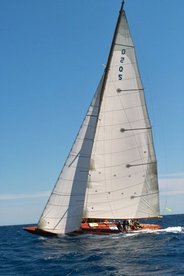
For instance, my standard for beauty on the Bolero project was Dennis Conner's restoration of the Q Class sailboat Cotton Blossum II.


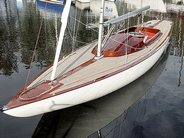
Now I think Tim did an extraordinary job with Bolero.


And we did jokingly discuss the consequences (time and money) of pursuing a "Cotton Blossom type" renovation. But in the end you have to admit that as stunning as Bolero turned out she is not in the same league as Cotton Blossom. For me this is just giving credit where credit is due. It doesn't take anything away from Tim's work. And I certainly don't get offend by it or have to rationalize my choices and Tim's work by showing pictures of botched restorations.

But just because I have made this choice doesn't make it the best or right. And I have no intention to try to force my ways onto anyone else. What gets to me is when people try to rewrite the definitions to support their own choices. I am hopeful that we can get to the acceptance stage where we can see the great choices, the good choices and the poor choices and talk about them equally.

Monday, August 18, 2008

How to Build a Sculling Oar by Jerome FitzGerald

As I mentioned I will be occasionally posting some of the writing of Jerome FitzGerald. I have read and reread all of his books (Wind and Tide, Sailing with Purpose and Sea-Steading). Jay is an opinionated SOB and I like that. While many people will tell you what you can't do without and engine Jay tells you how. He is really an inspiration for the enineless sailor. But having a thick skin is a must. If you are looking for him to reaffirm your beliefs you will come away bruised and battered. In my case, I don't sail for Jay, I sail for myself so I find his books a good read full of information that I find invaluable.

By permission, here is information on how to build a sculling oar.

How to Build a Sculling Oar
Jerome FitzGerald


Along this road, most all of what I read from modern sources when I built my first sculling oar was total bullshit, applicable only to dingy and such and there pointless--so I’m going to save you the hassle of the same mistake. It will cost you a couple hundred bucks to do build a sculling oar, so there’s no sense in failing. As well, to work right, a sculling oar needs to be built for a certain person on a certain boat to get the geometry right. This geometry is vastly more important than any other feature of the oar. So, we’ll figure it out.

So, I’m going to explain the whole deal to you so you can design a sculling oar.

First: why row, or why scull?

Rowing is very simple and simple in context. An oar is just a paddle. You push in through the water and it moves the water more or less at the same rate you push. The length of the oar allows you to get more(usually unfavorable) leverage so as to move more water more quickly. It generates speed. It generates power in direct proportion to how hard you push. On a small boat, and to me this means any boat of less than 4 tonnes or so, it’s a very sensible option. Not only does rowing allow for forward motion, but backwards, and also will aid turning. If this is your option, and you have a little boat, it’s easy. Mount good solid oarlocks go at it. You can’t overdo the mounting of the oarlocks.

Sculling has nothing to do with rowing, and the action is utterly different. It doesn’t move water in even close to the same way. What a sculling oar is—not a paddle—but a propeller. And it’s a really really big very shallow pitch propeller. If in powerboat terms a “square” propeller—one that is say 36 inches in diameter and moves 36 inches of bite in one revolution—is considered powerful, a sculling oar is off the scale. Rather than square, a typical sculling oar in propeller terms could be a 200 x 36 screw. As such, and like the effect of any screw or other inclined plane, it generates a great deal of force at the expense of speed. As such, it’s the only sensible option for a large heavy boat, that you’re not going to move at more than about a knot or two anyhow.

The difference between a conventional propeller and a sculling oar is this. A propeller goes round and round. A sculling oar only makes about a quarter of a revolution and then reverses. Obviously that wouldn’t work with a propeller, as you’d go forward then backward, but on a sculling oar the oar is rolled so the pitch is reversed for the return stroke. This reversing “diving leaf” pattern is the key to sculling.


Ok, so there are different ways making the pitch reverse—but I’m going to describe the from the perspective of the plan old western bargemans sculling oar. I’ve come to believe this is the best. Yulohs, the Ro, all that, they all do the same thing. None is more magical than the other or in my mind significantly more effective. You don’t or won’t get something for nothing. You won’t replace even a small outboard with a sculling oar. You’re just not big enough to generate the juice. I imagine a sculling oar is about the equivalent of a ½ horsepower outboard. Still, you can move a big boat with that in a calm, applied smartly. It will keep you from drifting onto a beach when you can’t sail. Don’t expect to row out to the islands for the weekend unless you’re some kind of gorilla.


So back on topic, there are several different ways to make the pitch reverse. One, you can just grab the oar and rotate it. This works on little boats but will mess your wrists up in short order on a large one. A yuloh uses a lanyard that you give a jerk to to get it to roll. We’re going to use a lanyard, but we’re not going to touch it as jerking the rope back and forth will tear your hands up.’I’ve seen trailer hitch balls and all sorts of other stuff too. No, no, we’re just going to the simple thing. We’ll just put a bend in the bottom of the oar.

On a traditional barge style sculling oar there is a pronounced bend to the lower end of the loom(what the shaft is called) before the blade. This is there for two reasons . First of all, you want to be able to stand on deck, facing aft, with inner end(handle end) of the oar just about at chin level. You want the middle of the oar to be at the chock at the transom, but as the blade intersects the water you want to do so a better than 45 degree angle. 60 is better. Why? Because just like a propeller, you want it facing aft, not up, as it’s the sensible way to direct the force that comes off the blade.


Now consider what happens when you swing the oar—that bend wants to twist the oar in the notch and drag behind the stroke. As it does so, it imparts an angle of attack, of bite and pitch, to the blade, doesn’t it? There you have it—self feathering.


The biggest difference between dingy sculling oar and big boat sculling oars is the amount of bend. You don’t need a lot of bend in a little sculling oar because it will bend a bit and feather. A big oar won’t—or shouldn’t as you’ll be throwing all your body weight on it and you’ll just bust it. You’ll be quite amazed at the power it makes. We’re talking about hundreds of pounds of thrust.

Hence the lanyard on the inner end. Obviously as the blade dives, it wants to pick up the handle end. You can’t let that happen, as you lose all your thrust. So, you have a lanyard on the inner end holding the loom down so all you have to worry about is hucking the shaft from side to side. I find that I like to put both hands over the end of the oar and pull squat from one side to the other. When you have the motion right, the dig is so hard it will nearly support your weight. Practice. You’ll see.

So, at this point we can see that the power we’re building will raise all hell on your transom unless it is built to take the prying action of a 4x4 sixteen or so feet long. Don’t even consider silly little oar locks, or even big ones. You’ll break them. What you want is a nice rounded chock at least 2 inches thick and 5 inches deep, backed up with a couple bronze thole pins of maybe 1 inch on either side to make sure you don’t roll the oar out. It needs to be husky. Don’t make a mistake about that. If anything breaks while you’re sculling, you’ll either spill it in the cockpit hard or go over the side, which would be stupid. Keep the chock well greased. Use Vaseline or Bag balm, as I find that keeps best.

How to build a sculling oar.

Buy a clear fir 4x4 14-16 feet or so long, depending on your boat and aforementioned geometry. This will be the loom. Longer is generally better, if you can stow it. If you can’t find one, you could laminate one up, but clear is nice.

For the blade, you’ll want a piece of some wood, a good hard fir is fine but ash, elm, white oak, or other will work as well—about 6 to 8 inches wide about 36 inches long. This will be the blade, which will be clothespinned into the end of the loom shaft. Some people will be tempted to get all weird about the profile of the blade, about foil section and all that. Great. Fair it, but beyond that I don’t think it matters much. Just be sure that if you put a wonky profile into the blade make it face the right way! Don’t laugh—the nicest sculling oar I ever saw had the lift face in backwards. Bulge in the wing forward, which is up, towards the lift, or the low pressure face, right? Think propeller!

Take the skillsaw and make two rip cuts clear through the 4x4 starting from the what will be the lower end of the loom up towards the center. This splits the 4x4 at that end into three pieces, which will allow you to bend that end. Make the cuts so that the remaining piece in the midde of the 4x4 is the same thickness as the head of the blade.

With the skillsaw make the square 16 footer into an octagon by setting it at 45 degrees and taking the corners off. Be careful, of course, as if you cut an artery you do no sculling.

Now the clever spar makers bit. Mark the oar with a felt tip at 1 foot intervals. Figure that in the middle two feet it will remain about four inches thick. Figure at the handle end, and probably blade end too, it will be about 2 and a half thick and round. You want nice taper but not stand around in a nicely pressed pair of carharts and fart with a drawknife for two weeks. So, set skill saw back to 90, and set the blade depth to 3/4 . Take the saw and cut a whole bunch of cuts into the last foot of both ends. Now set the saw to about an 1/8 less and do the same to the next foot in, of both ends. Repeat until you get near the middle. Now get a beltsander with 36 grit or tougher—or a powerplane if you’re brave, and peel away until all the saw marks are gone. Bingo, you’ve got a double tapered, round loom shaft.

Notch back the center piece of the 4x4 ten inches or so you can stick the blade in there.

Set up a bending jig. Stick the loom end under something immovable, over a pivot point, and dog, handybilly, bar clamp or something the lower end into the shape you want. Test fit, release. It will be a husky bend. Don’t let it snap back and bash your face. Shoot the scarfs full of semi-thickened epoxy, crank her back down, stick the blade in, and clamp the whole works together with 4 or 5 c-clamps.


Let the glue set up. You’ve an oar. Finish it to your personal level of fetish.


Copyright 2006 Jerome FitzGerald