


 BOAT SAILING
THE KNOCKABOUTS, which had their origin in

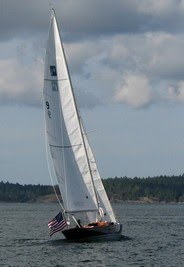
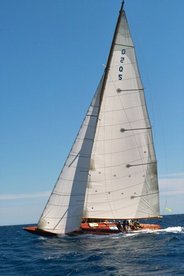
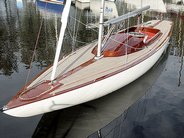
This class gained popularity from the intrinsic excellence of the boats themselves, combining capital cruising qualities with fair speed and good accommodations. Several designers competed, the restrictions governing their construction, dimensions, and sail area being such that the boats were very even in speed, and the contests in which they took part were keen, close, and exciting.
length over all, 33 feet; on the load waterline, 21 feet; beam, 8 feet 8 inches; draught, 4 feet; with board down, 7 feet.
SEAWANHAKA 21-FOOT KNOCKABOUT
 The area of the mainsail and jib contains 550 square feet. The centerboard is a small one of iron, and houses below the cabin floor. The trunk cabin is 8 feet long, with 5 feet headroom. The price of these boats was $750 complete, and, their construction being sound and strong, they will, if taken care of properly, be good for many years.
It is impossible to speak in terms too high of this class after a surfeit of the racing machines and freaks like the 20-footers whose alarming antics so often amused and amazed us whenever they happened to meet in a reefing breeze. Another good property they possess is that they look like boats when hauled up on the beach, and can never be mistaken when their masts are unstepped for pig-troughs or fish floats. There is no doubt of the sea worthiness of these craft. They are perfectly safe in a northwest squall off

Another craft of this type which was deservedly popular last year is of larger size than the one described above. She is 25 feet on the load waterline, 38 feet over all, with a beam of 8 feet 6 inches, and 5 feet draught with centerboard up. The boat, which was designed by Mr. B.B. Crowninshield, of
SAIL PLAN OF SEAWANHAKA KNOCKABOUT 550 SQUARE FEET

Personally, I favor a short bowsprit in a knockabout, it being convenient for hoisting the anchor, keeping it clear of the hull, and preventing unseemly dents from the flukes.
I fear that knockabouts, or raceboats, even in restricted classes, are designed eventually to be fitted with fin-keels. As a speed-inducing factor the fin has fully demonstrated its capacity since the first edition of this little book appeared. I have not, however, altered my opinion one iota since my remarks on the ballast-fin made in the chapter which precedes this. In my judgement the fin is admirably adapted as an adjunct to a racing machine, but for cruising craft I like it not. Brand me for an old fogy, if you will; half a century behind the times, if it so pleases you, shipmates, but give me credit for sincerity.
The keen sense of rivalry inherent in every American will not permit him to be content with a good, honest sailing boat for cruising purposes only. If one of his chums comes out with a faster craft, whether a fin-keel or a modification thereof, he will become dissatisfied with his own boat, no matter how seaworthy and comfortable she may be, and will promptly discard her for a newfangled design in which speed is the principal characteristic. The so-called restricted classes, which are so popular just now, are, I think, sure in the end to become purely racing classes, something after the fashion of the Herreshoff 30-footers now so fashionable in
The one-design classes of small yachts are not confined to knockabouts only. Cruising schooners, designed by Cary Smith, made their appearance in 1898, and the class, from a modest beginning, seems likely to grow. The features of the boats are their sound and wholesome characteristics. They possess moderate draught, large accommodations, and strength of construction. They are 64 feet 2 inches over all, 46 feet long on the load waterline, 16 feet beam, draught without board 6 feet 6 inches, least freeboard 3 feet. A rather low cabin trunk gives full headroom for the greater part of the yacht's length, the main saloon being more than 13 feet long, with a floor width of 6 feet 9 inches. On each side are two berths and two sofas with drawers beneath. There is accommodation in the forecastle for four men. The yachts carry 20,000 pounds of lead ballast, of which 18,000 pounds is on keel. Another one-design division is the Riverside Yacht Club dory class, which has been adopted by many of the clubs enrolled in the Yacht-Racing Union of Long Island Sound. These boats are thirteen feet on the keel, seventeen feet over all, with four feet beam, fitted with a centerboard and rigged with small jib and a leg-of-mutton sail. They are for single-handed racing, but for pleasure cruising or fishing a man can take his chum along. Fully equipped with oars, sails, etc., they cost about forty dollars, and afford capital sport on fine afternoons. To encourage this little class, prizes worth winning are offered by the club, and sweepstakes races are popular features.
The idea was probably taken from the Nahant Dory Club, organized in 1894, which did much to encourage sport in this serviceable and inexpensive class. Spectators will find amusement in watching "green hands" in their maiden efforts at sailing these dories, as strange and startling results often follow the rash experiments of an adventurous tyro. But apart from the comic element, valuable lessons in yacht racing may be learned by steering and maneuvering a dory against a fleet of half-a-dozen eager competitors. Thus, yachtsmen cannot help approving this new
The origin of the one-design class was
The Water Wags are presided over by a king and a queen, bishop, knights, and rooks; and, although the boats were at first used principally for pleasure, they are now racers, pure and simple. Their headquarters are now in
Each boat shall carry no less than two or more than three persons in a race, all of whom shall be amateurs. A member or any lady may steer. No prize shall be awarded a boat for a sail-over, but she may fly a winning flag therefor. A pair of oars and a life-buoy must be carried in every race. It is only right to mention that these sailing regulations are vigorously enforced.
Length over all, 37 feet 3 inches; length on load waterline, 25 feet; beam, 8 feet 8 inches; draught, 6 feet 3 inches; lead on keel, 3 tons 5 cwt., and sail area, 845 square feet, divided into a mainsail laced to the boom, gafftopsail, foresail and jib.
A second jib, jibtopsail, balloon foresail, spinnaker, storm jib and trysail may also be carried. The design, made by Will Fife, Jr., of Fairlie, is handsome, the type being eminently adapted for
That the classes are destined to prosper there is no doubt, the only condition being that the type must be carefully adapted to the location for which it is intended, and the more it is available for fishing excursions and pleasure trips the greater favor will attend it. Another helpful feature is the substantial economic gain from the construction of several boats by the same builder from the same design.
Reprinted with permission. The original version may be found here. And much great sailing info here.











+Luders.jpg)








 Posts
Posts



0 comments:
Post a Comment